Showing posts with label fiction. Show all posts

Wednesday, February 3, 2010

FICTION: the class of literature comprising works of imaginative narration, esp. in prose form.


My mind has been filled with fiction over the past week. I have been in the process of finishing a piece of fiction which has absorbed me. As I "put it to bed", in the sense of putting the finishing touches on it, editing it yet once more, having spent days editing it over the past month, and sending it out to several people to read for me, I have found myself at a familiar place. I have to ask myself, "Is this it? Am I done? Is it ready to go to publication?" The temptation to keep editing is great.

I studied oil painting once with a very wise teacher. She was an artist of the old school, incorporating a good amount of philosophy of painting into a class already full of instruction in technique. I guess I'm more of an art philosophy person than an artist, because I remember her philosophical instructions more than her words about technique.

One thing she pounded into my brain: "When you are finished, you are finished. Put the brush down and walk away. The revisions you add from this point on will destroy the character of the painting." It was great advice. I find that I employ that advice even more in writing than I did in painting.

The secret was to know when you were at that point. As she so correctly taught, you know it more in your gut that you do in your brain. You stand back, look at the painting and say to yourself, "I'm done." It's not so much a rational decision as it is a gut feeling.

A second issue that raised itself when completing this piece is the distinction between my own story and pure fiction. I have come to believe that there is no such thing as pure fiction. Writing is not some abstract act that is disconnected from the writer. Rather, writing calls upon all of the personal qualities, skills, talents, and motivations which have been years in the making within the writer's person. A great word used in writing is roman a clef. It is a French word (pronounced "ro-mahn'-ah-clay") which describes a piece of fiction written around a personal experience. In many case the piece is a thinly-disguised story which is, in reality, a true story from one's own history.

As I said at the beginning of this piece, there may be no way to write fiction without it relating back to the writer's self. But that is different from a roman a clef. The fact that a writer's traits can be seen in a piece of fiction does not mean that the story is about the writer. A roman a clef is an intentional re-telling of a personal story.

I raise this because the piece I have just finished is so far from my own life, story, and childhood that I am amused by my having written it. Granted, I can see traits in the story that are familiar, and the locations chosen are places I have known personally. Apart from that, however, I feel as if I have just met a new person. I like him. And I like his story.

The bottom line: I like this book. I can't wait for it to be published .

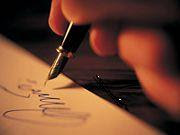
Graphic Credit: www.outpost-daria.com/fan_fiction.html
Definition Credit: Dictionary.com Unabridged
Based on the Random House Dictionary, © Random House, Inc. 2010.

Tuesday, December 8, 2009

VERISIMILITUDE: a statement which merely appears to be true (wikipedia.com)


Verisimilitude is a word that comes from the world of writing fiction. It emerged with the onset of fiction as a popular form of literature, causing some consternation among literary critics. Is the story meant to be true, or is it imaginary? How is the reader to know? What if the reader doesn't understand that it is not a true story? Each of these questions puts the responsibility on the author to acknowledge the truth or lack of truth in the story.

As popular fiction emerged in literature, the onus for determining the mindset of the story shifted more and more to the reader. In contemporary literature that is the understanding: the reader is to utilize his or her skills in sorting through the veracity of the story. The suspension of disbelief on the part of the reader became a function of verisimilitude, the ability of the author to create a reality base by which the reader can allow the suspension of disbelief in order to capture the essence of the plot without difficulty.

It is increasingly difficult to sort out the fictional aspects of writing from the factual reporting as the use of fantasy in literature explodes. The recent literary phenomenon, Harry Potter, is a prime example of the diminishing border between fantasy and truth. Verisimilitude is rampant, as fact and fantasy are woven skillfully by the author, JK Rowling. Her application of verisimilitude techniques establishes a reality base upon which the readers (particularly children) can allow their imaginations to soar, all the while accepting the reality of Harry and his friends.

In the 21st century the employment of verisimilitude is not simply a literary technique. It is also a journalistic technique. The clever utilization of fact, fiction, fantasy and fabrication (how about that for alliteration?) in journalism and commentary lead to confusion by the public about truth.

We are told that the young adult population of the United States is dependent upon the clever weaving of these factors, in humor, for its access to current news and events. My perception is that Generations X, Y and Z (if there is such a thing!) are skilled far more than my War Baby generation and the Boomers. Today's youth are bred upon a kind of literature (written, aural, and visual) which allows them to filter through the humor of Jon Stewart and The Daily Show in order to siphon the news as Stewart reports it. The onus on public figures is to be aware of the significance of this medium and treat it with the same respect as they might the 6:30 national news.

Verisimilitude has much to do with the appearance of reality in the midst of fiction. Thus, there is a pressure on those utilizing new methods of communication to employ verisimilitude in a moral and ethical manner. I'm not sure the rules for this have emerged clearly. 24 hour talk radio and TV, cable television, and easy access to the publishing field create a literary atmosphere which is rapid, sometimes clumsy, and often malicious. Verisimilitude as a literary technique is sometimes lacking.

Monday, November 23, 2009

roman à clef: a novel in which actual persons, places, or events are depicted in fictional guise. (Dictionary.com)

----------

I love this word/phrase. It is pronounced rōmäN' ä klā'. What I love about it is that it is something that happens intentionally to some authors, and unintentionally to many, many others. My suspicion is that it is a surprise to many authors to discover that their novel is more autobiographical than they expected. When I first began to explore the realm of fictional writing I was told that when an author begins to write the themes are drawn from that which is most familiar. The comfort level with their own story is available and approachable, allowing the author (either consciously or unconsciously) to focus upon the act of writing without struggling to develop a story.

A...common type of roman à clef is one in which the disguised characters are easily recognized only by a few insiders, as in Simone de Beauvoir's The Mandarins (1954).(Encyclopedia Britannica Online)

Developing a story line is a far more complicated process than many might expect. For me, at least, it begins with a simple idea (sometimes a word) and begins to unfold as I write. Sometimes there is a skeleton of a story in my mind or in my notes. But many times the story evolves as I write. There comes a point where I have to know the ending in order to arrive there effectively. But that ending may change numerous times in the course of writing.

Back to roman à clef , however, the fictional story may begin with an actual experience, but there comes a point where it must vary in order to become the short story or novel it is intended to be. This is where a roman à clef differs from an autobiography. Just changing the names and disguising the location is not enough. A new element must be introduced into the story which changes the facts.

Gradually, as an author begins to emerge into his or her voice the need for autobiographical information diminishes and plot begins to develop independently. There is a rush when this happens. It is as if another part of the brain has been tapped. Personal experience is not lost, necessarily, but its role in the product is diminished and may only appear incidentally.

John Irving, the novelist, for instance, writes almost exclusively about New Hampshire. His prep school and certain character types are in almost every one of his novels. But, whereas his earlier novels were specifically about Exeter and specific people, in more recent novels they have become more or less references which are laced into the story in a less prominent way.

It occurs to me that roman à clef is not restricted to the writing of novels. Isn't it true that this is a characteristic of social conversation, as well? When we first meet a new friend, there is much talk about personal background. As the relationship progresses, new material emerges as the common bond. Personal experience is not lost, but its prominence is not as visible as jointly-experienced moments become of greater significance.


Dictionary source:The American Heritage® Dictionary of the English Language, Fourth Edition
Copyright © 2009 by Houghton Mifflin Company.
Published by Houghton Mifflin Company. All rights reserved.